What is Freemasonry?
History, values, and what actually happens
From a lodge that has been practising Freemasonry for nearly a century.
Freemasonry is one of the world's oldest and largest fraternal organisations. There are around six million Freemasons worldwide, and over 200,000 in England and Wales alone.
Freemasonry is a fraternal organisation. Its members are of many faiths and none. It has no involvement in politics. Its traditions are private, not its existence: men meeting in friendship, following a shared moral code, and giving back to their communities.
An introduction from the United Grand Lodge of England
Core principles
Brotherly Love, Relief, and Truth
Brotherly Love
Freemasons are taught to regard all people with tolerance, respect, and kindness. The lodge is a place where that practice begins: men of different backgrounds, beliefs, and professions meeting as equals.
Relief
A commitment to charitable giving and to helping those in need. Freemasons in England and Wales give over £50 million to charitable causes every year, supporting hospitals, hospices, education, and community projects across the country.
Truth
A high standard of moral behaviour, in the lodge and outside it. Freemasons are expected to be honest in their dealings, reliable in their commitments, and accountable for their actions.
These three principles are not aspirations. They are expectations. Every Freemason takes an obligation to uphold them when he joins.
Craft Masonry
The Three Degrees
Every Freemason passes through three degrees. Each is conferred by ceremony: a combination of ritual, symbol, and obligation that has remained largely unchanged for centuries.
The first degree. A new member is initiated into the lodge and introduced to the principles of Freemasonry through ceremony, symbol, and obligation. The degree teaches humility: the candidate is entering something larger than himself and is asked to listen before he speaks.
The second degree advances the member further, with an emphasis on learning and the application of knowledge. The Fellow Craft is encouraged to study, to improve his mind and contribute more fully to the world around him.
The third and highest degree of Craft Masonry. The ceremony is dramatic and moving, and is considered the centrepiece of the Masonic experience. A Master Mason has full standing in the lodge and is encouraged to put into practice everything he has learned.
The governing body
The United Grand Lodge of England
Founded in 1717, the United Grand Lodge of England is the oldest and largest Grand Lodge in the world. It regulates Freemasonry in England and Wales, sets the standards for ritual and conduct, and represents English Freemasonry internationally.
Every lodge in England and Wales, including Fortis Green Lodge, is constituted by the UGLE and operates under its constitution. The UGLE publishes its accounts publicly, and its headquarters, Freemasons' Hall on Great Queen Street in London, is open to visitors.
Fortis Green Lodge is also part of the Metropolitan Grand Lodge of London, the provincial body that oversees nearly 1,200 lodges and over 28,000 Freemasons across the capital.
Our lodge
Consecration and Background
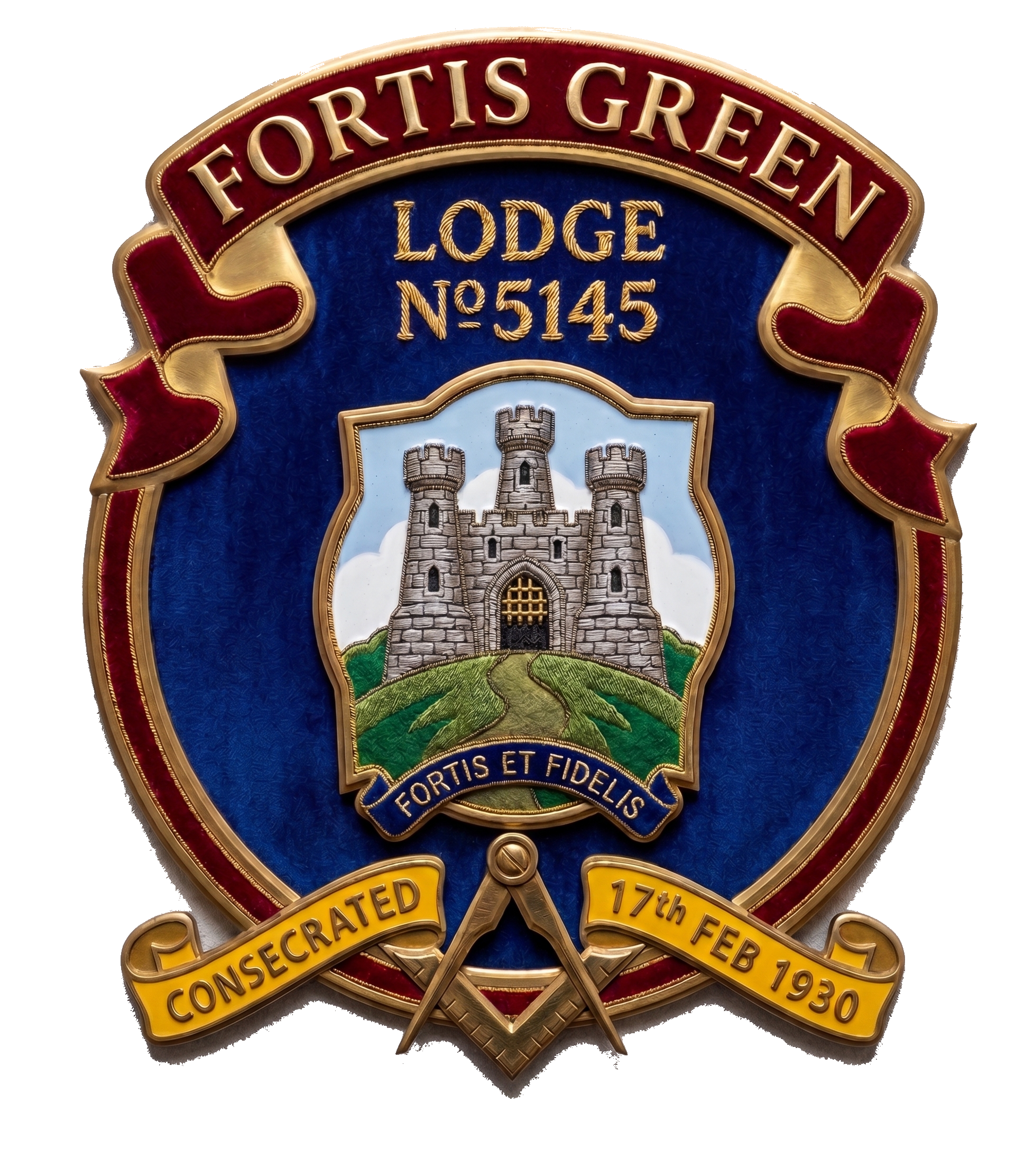
Fortis Green Lodge No. 5145 was consecrated on 17th February 1930 under the United Grand Lodge of England, founded by a group of local tradesmen and shopkeepers from the Fortis Green area of North London. Consecration is the formal founding ceremony of a new lodge, conducted by senior officers of the Grand Lodge. It establishes the lodge, appoints its first officers, and binds it to the obligations of Craft Masonry.
The lodge works Taylor's Ritual, one of the most widely practised workings of Craft Masonry in England, named after the brother who codified it. The three degrees are conducted in full, with the ritual performed from memory by officers who take that responsibility seriously.
We meet at Freemasons' Hall, 60 Great Queen Street, London WC2B 5AZ, the home of English Freemasonry since 1776 and one of the finest Art Deco buildings in London. Five times a year: September, October, December, March, and April.
Charitable giving
Freemasonry and Charity
Charitable giving is built into Freemasonry, not as a bolt-on but as a core obligation. The principle of Relief means that Freemasons are expected to support those in need, both within the brotherhood and in the wider community.
In England and Wales, Freemasons give over £50 million to charity every year. Much of that flows through the Masonic Charitable Foundation, which supports Freemasons, their families, and the general public through grants, care homes, and education funding.
At lodge level, Fortis Green Lodge fundraises at every festive board (primarily through a raffle) and makes direct grants to local community organisations. In 2025 we made a £500 grant to Big Up Communities in South London. See our community impact →
Female Freemasonry
Women and Freemasonry
The United Grand Lodge of England governs male-only lodges. However, there are two separate, fully established Grand Lodges for women which practise the same traditional Craft ritual and uphold the same principles of Brotherly Love, Relief and Truth.
The Order of Women Freemasons (OWF) and the Honourable Fraternity of Ancient Freemasons (HFAF) are the two principal female Masonic bodies in England and Wales, with combined membership in the tens of thousands. Both are long-established, independent, and thriving.
If you are a woman interested in Freemasonry, we would encourage you to explore both organisations directly. The principles, ceremonies, and commitment to charity are the same.
Further reading
About Freemasonry
The UGLE's own introduction: history, principles, and common questions.
ugle.org.uk →
Masonic Charity
How English Freemasonry gives back. £50m+ per year to thousands of causes.
ugle.org.uk →
Metropolitan Grand Lodge
The provincial body for London. Nearly 1,200 lodges and 28,000 members.
londonmasons.org.uk →
Interested in joining Fortis Green Lodge?
No obligation. Just a conversation. Come to a dinner first and meet the people.